
In football, every team studies game film. Coaches rewind plays, analyze mistakes, and call out the exact moment a defensive line missed an assignment. Nothing is hidden and nothing is forgotten because it is all there on tape.
Underwriting teams deserve the same kind of transparency. Every decision, edit, and approval should be visible in one place. Without that visibility, compliance officers are left playing detective instead of coach, piecing together fragmented records just to understand what happened. That slows everything down, and in a world where speed and accuracy drive revenue, we cannot afford that kind of drag.
The Pain Points Compliance Officers Face Today
For compliance and security officers, underwriting case management is akin to a team trying to play from 4 or 5 playbooks simultaneously.
One team handles risk checks in System A, another runs fraud reviews in System B, and a third pulls credit reports from System C. This lack of integrated workflows forces compliance teams to piece together approval timelines, scrolling back through email chains and Slack threads just to figure out who approved what and when.
According to a recent study, underwriters spend 30-40% of their time on operational tasks, like cleaning up data, chasing missing information, and rekeying documents. The longer teams spend on manual, time-consuming, repetitive supporting tasks, the more that eats away at strategic work that leads to growth.
For most compliance and security officers, the current state of underwriting case management is a mess. The day to day often looks like:
- Digging through scattered case notes across email, chat threads, PDFs, and old case files.
- Jumping between systems for identity verification, fraud checks, credit pulls, and manual data entry
- Re-entering information over and over again across underwriting tools because systems don’t talk to each other.
When auditors or regulators request evidence, institutions without unified, traceable records are left scrambling, often unable to quickly show who flagged a risk, when, or why. That increases exposure, slows reviews, and damages customer experience.
The High Cost of Getting It Wrong
The stakes are higher than most realize. Non-compliance does not just mean a warning. It can mean millions lost in fines, business disruption, and reputational damage. The numbers speak for themselves:
- The average total cost of non-compliance is $14.82 million, compared to $5.47 million for properly implemented compliance programs. It is nearly three times more expensive to get it wrong than to do it right.
- Firms spend about 2.71 times more on the fallout from non-compliance than they do on maintaining compliance programs.
- Roughly 43% of non-compliance costs come from business disruption and lost productivity, not just fines.
Transparency isn’t optional. It’s the difference between protecting your institution and paying for its mistakes.
Worth’s Case Management 2.0
Case Management 2.0 brings the team under one playbook by building audit trails directly into the underwriting workflow.
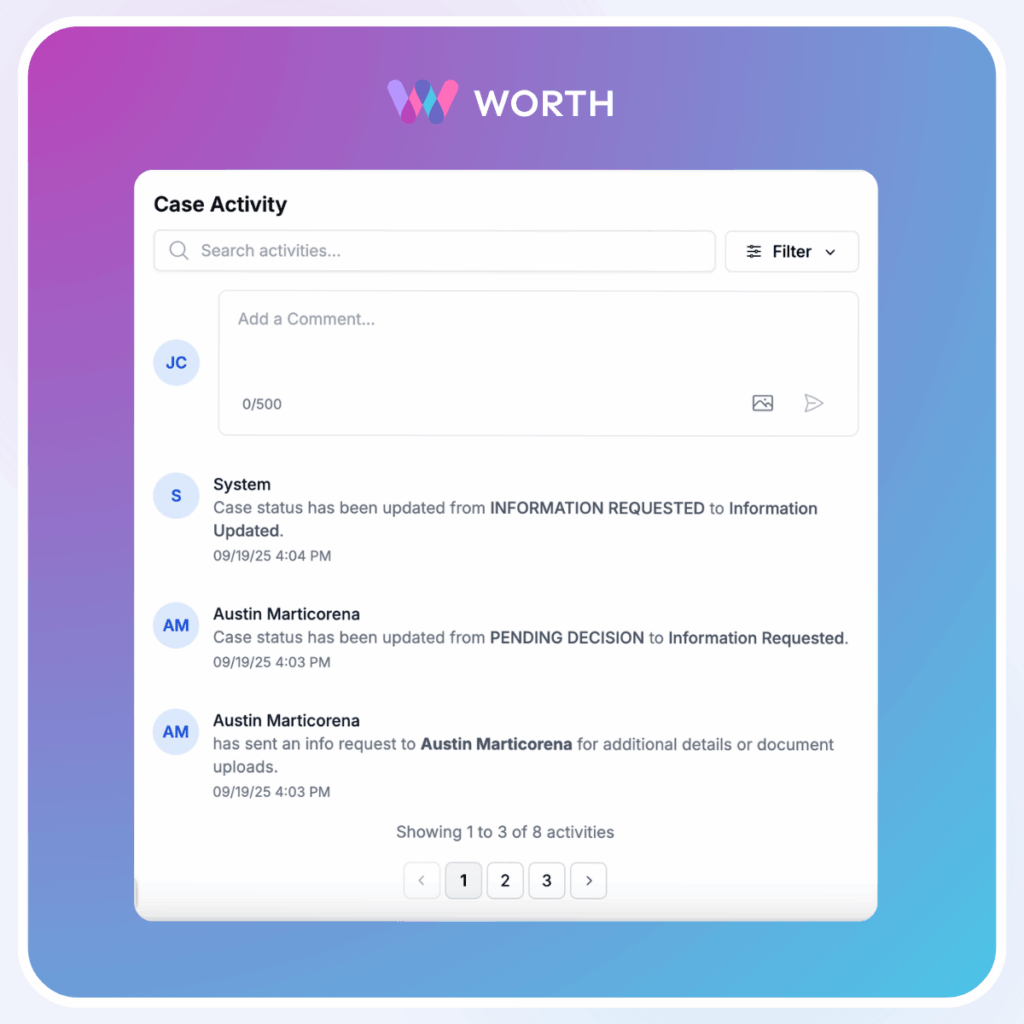
Instead of relying on external systems or scattered documentation, Worth compiles case data, comments, and actions in one place. The result is a single source of truth that underwriters and compliance officers can both rely on.
Underwriters can now leave comments directly within a case, creating a living record of decisions as they happen. Context is no longer lost in email chains, Slack threads, or Teams because the discussion is embedded into the application itself.
Each change, approval, and action is automatically captured in a transparent timeline, making it easy to follow the sequence of events from beginning to end.
For compliance officers, this means instant access to the full history of a case without the wasted hours of reconstructing timelines hopping between multiple systems. When regulators or auditors ask for evidence, everything is already there, clearly documented for seamless review.
Yesterday, it slowed you down. Today, compliance has moved from the sidelines to the center of the playbook.
Conclusion: From Transparent Playbooks to Performance Gains
Just as great teams improve by analyzing the film, refining the playbook, and learning from every play, great underwriting teams improve by making their process transparent.
Case Management 2.0 turns underwriting into a process you can actually review. Each step is logged. Each comment is captured. Each decision is clear. That means fewer blind spots, faster workflows, and stronger compliance.
Want to see how Worth can optimize your underwriting? Request a demo today.
Related posts
Access additional resources and insights to support your goals and drive success.

Why Customers Choose Worth for Faster, Smarter Underwriting
Worth helps teams onboard businesses faster, reduce risk, and scale underwriting without adding operational friction. See why fintechs, ISVs, and…

Clone Cases with Speed: Accelerate Time to Revenue with Underwriting Automation
What if underwriting workflows scaled the same way businesses do? Clone Cases reimagines case management by creating a repeatable system…

A Lookahead at Worth in 2026
As we wrap up 2025, the Worth team is already looking ahead to an ambitious year of travel, connection, and…