
Whether you’re processing a high volume of applications or working closely with merchants to complete them, the ability to easily start, track, and edit applications is essential for maintaining workflow efficiency and data accuracy.
That’s why Worth has continued to evolve the application experience across both Onboarding and Case Management. From starting an application directly inside the platform to tracking completion progress and fine-tuning details like NAICS/MCC codes, the latest updates are designed to give underwriters and operations teams more control, fewer manual steps, and clearer visibility from start to finish.
In this blog, we’ll walk through the three core pillars of these improvements:
- Starting applications — new pathways inside Case Management and streamlined workflows for completing applications on behalf of businesses.
- Tracking applications — better visibility into application progress and safeguards to prevent premature status changes.
- Editing applications — more flexibility to update critical details, including industry classifications, even after submission.
Let’s dive in.
Starting New Merchant Applications: Two Paths
Every underwriting team works differently. They don’t all begin applications the same way, and most platforms don’t account for that. Many systems force teams into rigid onboarding flows, offer no clean way to fill out applications on behalf of merchants, or slow operators down with multi-step setup processes just to get a case started. Worth removes those bottlenecks by giving teams flexible options that match the realities of their workflows.
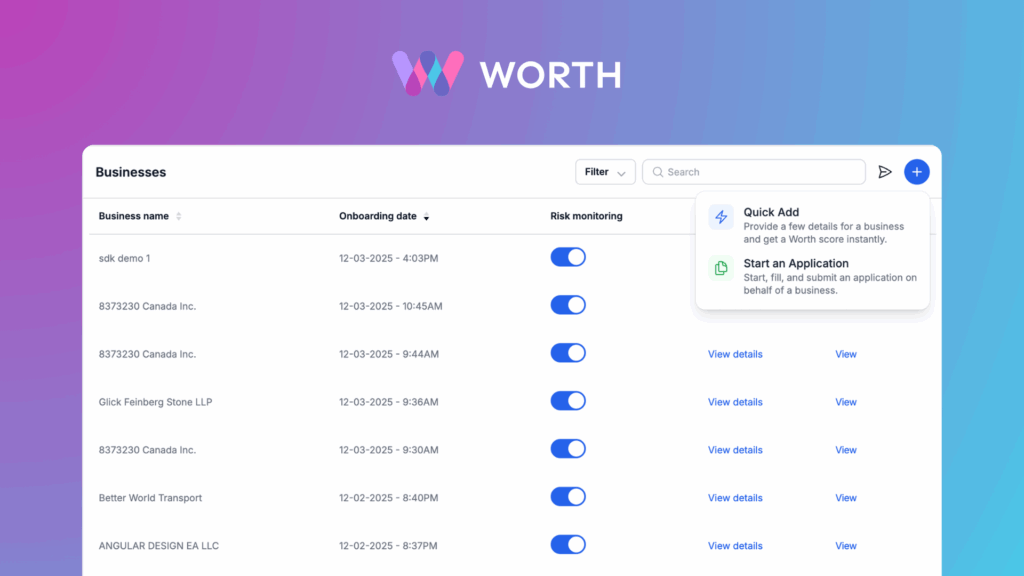
Option 1: Quick Add
Quick Add is built for speed. High-volume teams can instantly create a business record and generate a placeholder case without entering full application details upfront. This solves the common pain point of platforms that require complete data before a case can even be created, and it gives operators a fast way to queue up applications that will be completed later, whether by the merchant or another team member.
Option 2: Start From Case Management
Starting an Application from Case Management is designed for teams that frequently complete applications themselves. Instead of juggling tools, switching screens, or relying on ad hoc internal processes, users can launch a full onboarding flow directly from Case Management and enter business details end-to-end within a single environment. This option is ideal for ISOs, processors, or any organisation that works closely with merchants during onboarding.
By offering both a fast, lightweight path and a full end-to-end flow, Worth adapts to how underwriting teams actually operate. The result is faster onboarding, fewer bottlenecks, and a process that supports both speed and thoroughness, without the need for workarounds.
Tracking Applications: Visibility From Start to Submission
Once an application is started, teams need clarity on its status, its progress, and whether it’s ready for underwriting. Without that visibility, applications stall, statuses get out of sync, and teams spend valuable time chasing answers instead of making decisions.
For many organisations, tracking progress means juggling multiple screens, spreadsheets, or emails just to figure out how far an applicant has gotten in the onboarding process. That lack of transparency creates delays, manual follow-up loops, and inconsistent decisioning across teams.
Worth brings all of this information into one dashboard.
This level of visibility is especially key for high-volume teams or resellers who frequently manage onboarding for their merchants. Instead of guessing whether an application is almost ready for submission, underwriters can verify exactly how close it is to submission.
Editing Applications: More Control and Accuracy
The best onboarding systems rely on accurate data, but in the real world, that’s not always what underwriters receive. Auto-filled business profiles, outdated public records, or applicant-entered mistakes can lead to mismatched details, incorrect industry classifications, and ultimately, flawed risk decisions. Most solutions either lock this data or force teams into time-consuming backend edits.
Worth solves this by giving underwriting teams the flexibility to correct and refine applications at any point in the process. Instead of being stuck with whatever data was pre-filled or submitted, teams can adjust the information that matters most, ensuring the application reflects the true nature of the business before a decision is made.
Fix NAICS/MCC Codes Before They Cause Problems
The North American Industry Classification System (NAICS) and Merchant Category Codes (MCC) play a major role in how a business is evaluated. They influence everything from risk assessment to processor requirements, so getting them right matters.
But auto-assigned codes aren’t always perfect, especially in niche industries or businesses with multiple revenue streams. In many platforms, fixing these classifications becomes a support ticket, a backend engineering request, or a patchwork workaround.
Worth eliminates that friction.
Underwriters can adjust NAICS or MCC codes directly in the application, aligning classifications with their internal risk guidelines without delays or escalations. This leads to cleaner applications, more accurate underwriting, and fewer downstream surprises with processors or bank partners.
Refine Any Part of the Application for Cleaner, More Confident Underwriting
Beyond NAICS and MCC, customer users can now edit a broad range of application data:
- Company information (name, address, contact details)
- Ownership information
- Deposit account selections
- Banking details, including accounts pulled through Plaid
- International registration fields
- Custom fields that customers may use for internal workflows
These fields can be updated during application creation or after submission, giving teams complete flexibility to maintain clean, accurate applications throughout the case lifecycle.
Why This Matters
At the end of the day, underwriting teams don’t just need tools.
They need certainty.
Many legacy underwriting tools force teams into fragmented workflows. That leads to more manual data entry, slower starts for high-volume teams, and limited flexibility in how applications actually begin.
By giving teams better control over how applications start and flow through the pipeline, these features help institutions stay compliant, scale efficiently, and make decisions with more confidence.
For more information on any of these features or to request a walkthrough, reach out to our Product team or visit https://hub.worthai.com/demo-request.
Related posts
Access additional resources and insights to support your goals and drive success.

Why Customers Choose Worth for Faster, Smarter Underwriting
Worth helps teams onboard businesses faster, reduce risk, and scale underwriting without adding operational friction. See why fintechs, ISVs, and…

Clone Cases with Speed: Accelerate Time to Revenue with Underwriting Automation
What if underwriting workflows scaled the same way businesses do? Clone Cases reimagines case management by creating a repeatable system…

A Lookahead at Worth in 2026
As we wrap up 2025, the Worth team is already looking ahead to an ambitious year of travel, connection, and…